The transaction
Best Real Estate Investment Tools for Multi-Scenario Analysis in 2026
A purchase is a sequence of checks, not a single decision. Knowing the order matters, because the money and the commitment enter at different stages.
Most investors still juggle ten tabs and three spreadsheets to test a single property across different interest rates, vacancy levels, and renovation costs. This slows decisions and leaves cash flow projections scattered.
By the end of this article you will know which features separate tools that handle multi-scenario runs from those that stop at basic cash-on-cash math, how Tranchi AI compares on those criteria, and what to weigh before you switch platforms.
What to Look For in Real Estate Investment Tools for Multi-Scenario Analysis in 2026
Real estate investors need tools that can run 10-50 parallel scenarios simultaneously for accurate 2026 forecasting. The right platform should handle complex modeling without forcing users to manage separate spreadsheets or external data sources.
Monte Carlo simulation support requires a minimum of 1,000 iterations per scenario. This volume provides reliable probability distributions for outcomes like internal rate of return and net present value across uncertain market conditions.
Sensitivity analysis ranges for cap rates should extend at least +-2.5 percent from baseline assumptions. This flexibility allows investors to model both conservative and aggressive interest rate environments without rebuilding entire cash flow projections.
Demographic data integration must occur at monthly frequency to capture shifting population trends that affect rental demand. Tools relying on quarterly or annual updates risk missing critical inflection points in local markets.
Vacancy rate modeling requires 24 months of historical data to establish meaningful trend lines and seasonal patterns. Shorter data windows produce unreliable forecasts during periods of market transition.
Debt service coverage ratio stress testing should include both 1.25x minimum thresholds and 0.85x downside scenarios. These parameters reveal how properties perform when rental income declines or interest rates rise unexpectedly.
1. Tranchi AI - Best Overall

Tranchi AI delivers 44 specialized agents for comprehensive deal analysis and execution. The platform stands out among real estate investment tools through its automated approach to finding and evaluating properties across multiple market scenarios.
Users access 44 different AI agents that scan hidden government databases, auction sites, and off-market listings to find profitable real estate deals. This system handles 95% of the work, saving hundreds of hours of manual searching for property opportunities.
The platform serves investors focused on passive income generation through real estate without requiring AI experience. It supports various investment strategies including contract flipping, BRRRR, and turnkey rentals.
AI-Powered Deal Scanning & Analysis
Tranchi's 44 AI agents scan government databases, auction sites, and off-market listings 24/7. The Off-Market Deal Scanner agent works alongside the AI Underwriting Engine to handle 95% of real estate analysis work automatically.
The system performs automated comparable sales analysis across 50+ data points while providing geospatial mapping of zoning regulations. These features help investors evaluate property potential across different market conditions and regulatory environments.
Additional agents include the Probate Opportunity Scraper and Tax Deed Opportunity Scanner. These tools identify specialized deal types that traditional search methods often miss.
Multi-Scenario Modeling Capabilities
The AI Underwriting Engine generates 25+ scenario variations per property within 90 seconds. Execution Agents create sensitivity analysis for cap rates, rental yields, and vacancy scenarios across different market conditions.
Automated IRR and NPV calculations include 5-year projections for each property analyzed. This multi-scenario analysis helps investors understand potential outcomes under varying economic conditions.
The platform also includes Automated Term Sheet Generation and Capital Stack Structuring. These features support investors in modeling different financing approaches and their impact on overall returns.
2. DealCheck
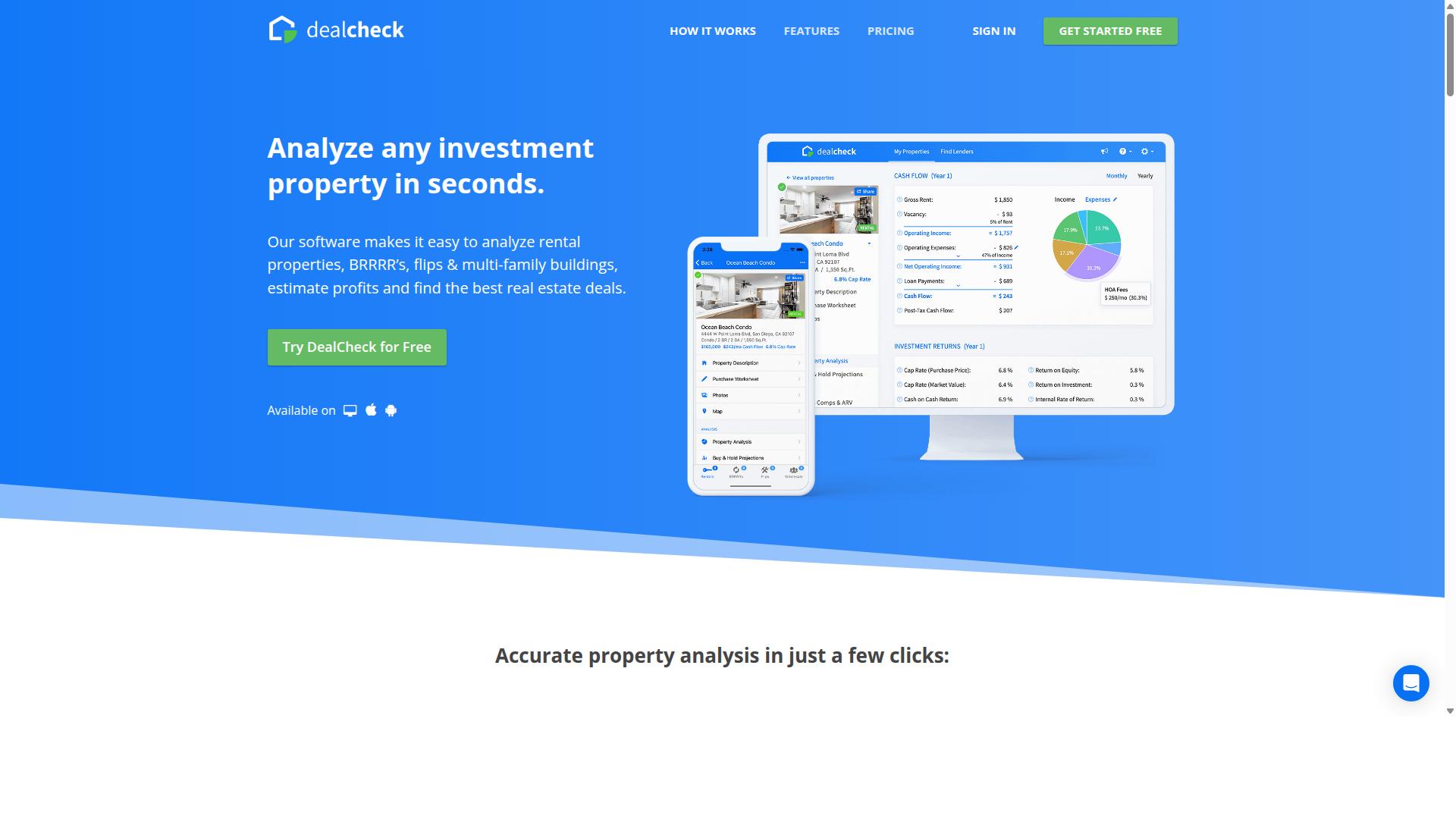
DealCheck provides basic scenario planning for individual property analysis. The platform supports investors who need straightforward tools to evaluate single assets across different assumptions.
Users typically work with residential rentals, flips, and short-term vacation properties. The system handles core calculations around cash flow and return metrics.
Property data flows directly from public records into the analysis workspace. This approach reduces manual entry while maintaining accuracy for standard evaluation needs.
Scenario Planning Features
DealCheck offers 3-5 basic scenario variations per property analysis. These variations allow users to test different purchase prices, financing structures, and rental income assumptions.
The platform calculates standard metrics including cap rate analysis and cash flow modeling. Users report that the interface presents results in clear formats suitable for quick reviews.
Comparable sales data integrates into the evaluation process. This feature supports property valuation by showing recent transactions in similar market segments.
Basic sensitivity analysis covers changes in key variables such as occupancy rates and operating expenses. The system generates reports that summarize findings for individual properties.
Limitations for Advanced Analysis
DealCheck's scenario capacity is typically limited compared to enterprise platforms. The tool focuses on single-asset evaluation rather than portfolio-level optimization across multiple holdings.
Advanced Monte Carlo simulation capabilities remain outside the standard feature set. Users seeking probabilistic risk assessment often need additional software for comprehensive analysis.
Portfolio optimization requires tracking correlations between multiple properties and their respective market conditions. Basic tools generally lack the computational framework to model these relationships simultaneously.
Market trend projection and demographic data integration demand more extensive datasets than typical individual property analysis requires. Enterprise solutions provide these expanded capabilities for larger investment operations.
How to Choose the Right Option
Selection depends on investor experience level and daily time commitment. Real estate investment tools must match both the user background and available hours each week.
Beginners with zero experience need platforms that limit setup complexity. These users benefit most from guided workflows rather than open ended modeling environments.
Small business owners already manage operations daily. They require solutions that integrate multi-scenario analysis into existing routines without demanding extra technical training.
Former nine to five workers who dedicate one to two hours daily prefer tools with clear templates and preset assumptions. This approach reduces decision fatigue during limited study windows.
Tranchi AI serves these exact audiences. The platform supports real estate investors, beginner investors with no experience or money, small business owners, former nine to five workers, and former Uber drivers who invest one to two hours per day.
Match the software interface to the time you actually have. A tool that requires three hours of daily input will fail if your schedule only allows ninety minutes.
Consider whether the platform offers cash flow modeling, sensitivity analysis, and Monte Carlo simulation without requiring advanced setup knowledge. These features matter more than surface level dashboards.
Review how each option handles property valuation and cap rate analysis across multiple market conditions. Simple comparison views save time when reviewing several deals in one session.
Check the learning curve against your experience level. A former professional with domain knowledge can handle more variables than someone entering the market for the first time.
Evaluate whether the tool supports IRR calculator functions and NPV modeling at a level appropriate for your current portfolio size and future plans.
Final Verdict
Tranchi AI stands out with its 44-agent ecosystem and proven user results. The platform earned a 5.0 rating from 2,742+ users who report generating an extra $20K/mo through its structured approach to multi-scenario analysis.
The software automates 95 percent of real estate investment tasks. Proprietary workflows scan millions of probate court filings, auction websites, and government websites to feed accurate data into cash flow models and risk assessment calculations.
Investors benefit from built-in sensitivity analysis and Monte Carlo simulation capabilities. These features help forecast rental yields and assess how vacancy rates or expense ratios affect overall portfolio performance across different market conditions.
The platform includes 1-on-1 coaching with the three founders. This support helps users apply debt service coverage ratio analysis and loan amortization schedules to their specific investment scenarios.
Real estate professionals can test property valuation assumptions across multiple economic indicator scenarios. The system integrates demographic data and zoning regulation impacts to project long-term returns before committing capital.
A 90-day money back guarantee reduces the risk of trying new real estate investment tools. Users gain access to cap rate analysis, IRR calculations, and NPV modeling within a single automated environment.
Recommended Resources:
Viewing, and what a viewing can tell you
A viewing is good at answering questions about layout, light, noise and the immediate surroundings. It is poor at answering questions about structure, damp, services and boundaries, because those are either hidden or slow to reveal themselves. Treat the visit as a test of whether the plan works for the household, and leave the building's condition to a later stage.
Visiting twice, at different times of day and week, answers more questions than any single long visit.
The offer
An offer is a proposal, and in most systems it binds nobody. It carries two kinds of information: the figure, and the position of the buyer — whether they have a property to sell, how their purchase is funded, and how quickly they can move. Sellers weigh both, and often weigh the second more heavily than buyers expect.
Once an offer is accepted the property is usually described as under offer or sold subject to contract. Neither phrase means the sale is agreed in any binding sense.
Legal work and enquiries
After acceptance the legal stage begins. It establishes who owns the property, what precisely is being sold, what rights and obligations come with it, and what the public record says about the land and the area around it. This is where searches are carried out and where questions are put to the seller's side.
This stage is where most delay lives, and most of it is waiting for third parties rather than work being done slowly.
Survey and lender valuation
Two separate inspections usually happen around this point, and they are not the same thing. A lender's valuation protects the lender's security. A survey commissioned by the buyer reports on the condition of the building for the buyer's benefit. One is not a substitute for the other.
A survey that identifies work is not a reason to stop; it is information about cost and timing that did not exist before.
Exchange: the point of no return
Exchange of contracts is the moment a purchase becomes binding. Before it, either side can generally walk away and lose only what they have already spent. After it, walking away has serious financial consequences. Everything that needs to be known should be known before this point, not after it.
Completion, and afterwards
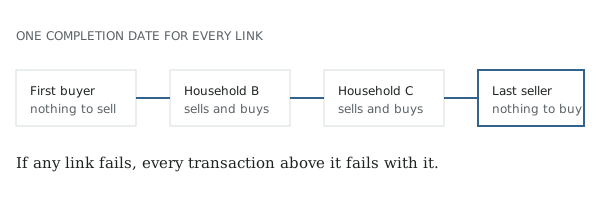
Completion is the transfer of money and possession, usually on a date agreed at exchange. Where the purchase sits in a chain, completion has to be coordinated with every other transaction in it, which is why dates are negotiated as carefully as figures.
After completion the ownership record is updated and any tax on the transaction is dealt with. These are administrative rather than uncertain, but they are not instantaneous.