The transaction
The 10 Best Investment Property Listings for Market Liquidity
A purchase is a sequence of checks, not a single decision. Knowing the order matters, because the money and the commitment enter at different stages.
You are comparing ten property portals and brokerages because liquid listings mean faster sales and fewer months of empty rent. The right platform decides whether your portfolio converts to cash in weeks or drags into quarters.
By the end of this article, you will know the specific indicators that signal a liquid investment property, the verification standards each platform applies, and which single listing service clears the bar for upfront reports and speed. You will also get a direct comparison of fees and sale timelines to make your final pick with confidence.
What to Look For in Investment Property Listings for Market Liquidity
Market liquidity in property refers to how quickly an asset can be sold at fair value, and for investors, spotting liquid listings early can mean the difference between trapped capital and flexible cash flow. When you can exit a position without heavy discounts or long waiting periods, you preserve both your equity and your options.
Liquidity matters for two core reasons: cash flow generation and exit strategy planning. A liquid property can be refinanced, sold, or repositioned with minimal friction, which keeps your portfolio agile in changing market conditions.
Certain listing features signal higher liquidity before you ever make an offer. Realistic pricing, evidence of strong rental demand, and clear documentation all point to a transaction that can close smoothly. The following indicators will help you separate genuinely liquid assets from those that look good only on paper.
Key Indicators of a Liquid Investment Property
Liquid properties typically share five measurable traits: realistic asking prices, high buyer-to-listing ratios, short average days on market, strong rental yields, and transparent due diligence materials. Each of these signals can be verified using standard listing data, and together they form a reliable picture of asset liquidity.
Here is what to check on every real estate listing before you commit capital:
- Pricing within 5% of comparable sales. Properties priced at or slightly below recent comparables attract immediate offers. Verify by pulling sold data for similar units in the same postcode from the last three to six months.
- Active buyer demand. Listings that have generated multiple inquiries or competing offers within the first week indicate a healthy buyer pool. Ask the listing agent directly how many viewings and offers have occurred.
- Average time on market under 30 days. Local market data will tell you the median days on market for the area. A listing that aligns with or beats that figure is priced and positioned for a faster sale.
- Rental yield above 5% for residential. Strong income coverage attracts both owner-occupiers and buy-to-let investors, widening your potential buyer base when you exit.
- Pre-sale reports available. A current survey, title report, and energy performance certificate remove friction from the transaction. Sellers who provide these documents signal they are ready to close.
Consider a concrete example: a property priced at GBP150,000 with a monthly rent of GBP800 yields 6.4%. That yield sits comfortably above the 5% threshold, meaning the property will appeal to income-focused investors. When you combine that yield with a realistic asking price and complete documentation, the listing is far more likely to sell quickly if you ever need to exit.
Pay attention to the listing agent's language as well. Phrases like "offers invited" or "priced to sell" often indicate flexibility, while vague descriptions about potential may signal overpricing. Seller concessions such as covering stamp duty or including fixtures can also accelerate a sale, but they should not mask an inflated valuation.
For commercial real estate, check the net operating income and cap rate against regional averages. A property with a cap rate that is too high may carry hidden risks, while one that is too low may not generate sufficient cash flow to attract buyers. The gross rent multiplier and debt service coverage ratio provide additional clarity for multi-family units and mixed-use buildings.
Finally, be cautious with distressed assets, auction properties, and off-market deals. These can offer excellent value, but they often come with limited documentation and unpredictable timelines. Unless you have deep experience with such transactions, their apparent discount may not compensate for the reduced liquidity.
1. Let Property - Best Overall
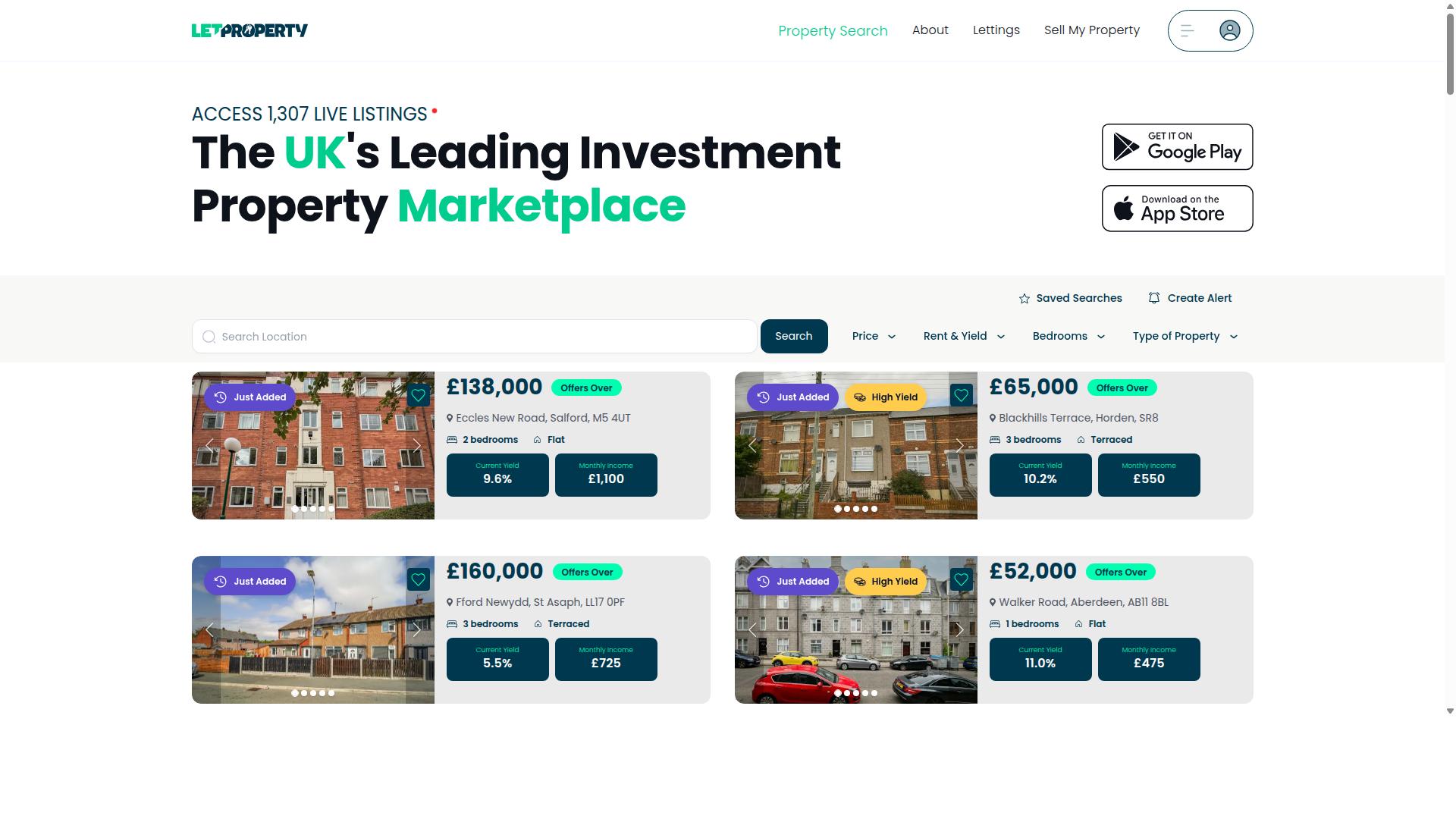
Let Property earns the top spot for market liquidity because its pre-verified tenanted portfolios come with all essential reports upfront, allowing buyers to move quickly and secure cash-flowing assets without lengthy due diligence.
The platform currently hosts 938 live listings spanning detached houses, semi-detached homes, terraced properties, flats, bungalows, land, commercial units, portfolios, and HMOs. This breadth means investors can find liquid assets across residential real estate and commercial real estate without juggling multiple marketplaces.
For liquidity-focused buyers, the key advantage is speed. Every property arrives with tenants already in place, so the rental income starts immediately after completion. That immediate cash flow strengthens your net operating income from day one, which matters when you are measuring rental yield and cap rate against your acquisition costs.
The fair first-come, first-served basis keeps transactions transparent and efficient. The first buyer to pay the premium secures the deal, removing the drawn-out negotiation cycles that often delay traditional real estate listings.
Pre-Checked Tenanted Portfolios with Upfront Reports
A key liquidity advantage is that Let Property provides essential reports (including legal, valuation, and tenancy details) before you even enquire, so you can make an offer with confidence and avoid weeks of back-and-forth.
In conventional property sales, due diligence can stretch across four to six weeks. Buyers wait on solicitors, surveyors, and managing agents to produce documents that should have been available from the start. That delay ties up capital and increases the liquidity premium you effectively pay for holding costs.
Let Property removes that friction. Because the legal, valuation, and tenancy paperwork is already prepared, you can assess property valuation and buyer demand quickly. You compare the gross rent multiplier and debt service coverage ratio against your targets without waiting for third parties to respond.
Trust is reinforced by customer feedback. 97% of customers rate their experience as good or excellent, based on 5,882 service ratings collected over the past year. That level of consistency suggests the platform delivers on its promise of transparent, fast transactions.
For investors targeting distressed assets or off-market deals, the structured approach here offers a cleaner alternative. You avoid the uncertainty of auction properties and the hidden costs that often surface after an informal purchase. Instead, you get a verified investment property with known cash flow and a realistic time on market.
2. PrimeLocation
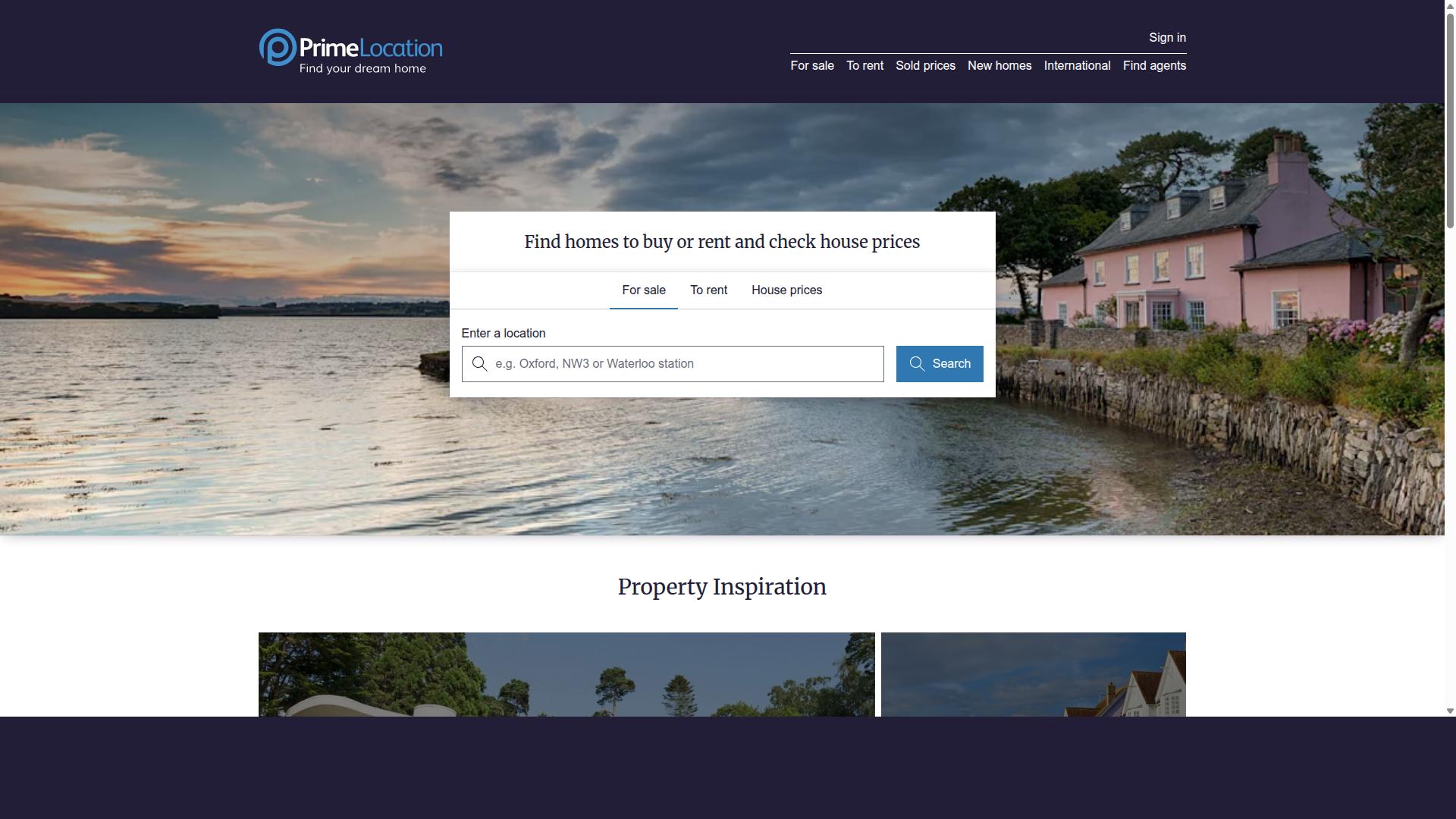
PrimeLocation is a major UK property portal with over a million monthly visitors, offering a broad range of residential listings that can be filtered by investment potential and yield. The platform aggregates listings from thousands of estate agents across the country, giving you access to a deep pool of residential real estate options in one place.
For investors focused on market liquidity, the platform's high traffic volume is a genuine advantage. Properties listed here tend to attract buyer interest quickly because the audience is so large, which can shorten the time on market compared to smaller portals. This matters when you need to convert an asset into cash without prolonged negotiation periods.
The advanced search filters are a practical tool for narrowing down opportunities. You can sort by price, location, property type, and even keyword terms like "investment" or "tenant in situ," which helps you identify single-family homes, multi-family units, and condominiums with existing cash flow potential.
One limitation to keep in mind is that PrimeLocation does not pre-verify listing data. You must conduct your own due diligence on property valuation, rental yield, and local buyer demand before committing to any purchase.
To assess liquidity more accurately, use the platform's sold prices tool. This feature shows recent transaction data for comparable properties in the area, giving you a clearer picture of how quickly homes are moving and at what price points. Compare these figures against current asking prices to spot overpriced listings that could stall your exit strategy.
Experts recommend cross-referencing sold prices with average listing durations. If similar properties are selling within weeks rather than months, that market segment likely offers stronger asset liquidity and a lower liquidity premium risk.
3. Rightmove

4. OnTheMarket

OnTheMarket positions itself as the portal with fewer, more quality listings, and its 'featured' properties often come from independent agents, which can mean less competition and faster negotiations. Because every listing comes from an agent who pays a fee, the platform tends to attract professionals who are serious about selling, not just testing the market.
For investors focused on market liquidity, this curated approach can be a real advantage. Fewer duplicate listings mean less noise when you are scanning for opportunities, and well-priced properties may spend less time on market since buyers arrive with clearer intent. The trade-off is a smaller overall inventory compared to larger portals, so you may need to check back regularly.
To find motivated sellers, use OnTheMarket's search filters to look for properties marked with a 'price reduced' indicator. These flags signal seller motivation and can open the door to negotiation, especially for distressed assets or properties that have been sitting unsold.
When evaluating a reduced listing, compare the current asking price against recent comparable sales in the area. A genuine reduction often reflects a seller who is ready to move, which can improve your position on price and closing timeline. This matters for asset liquidity, since a faster purchase process helps you deploy capital into cash-flowing investments sooner.
5. Savills

Savills is a global real estate advisor known for high-end residential and commercial properties, where liquidity is driven by prime locations and strong international demand. The firm operates across numerous countries, offering property sales, lettings, and specialist services such as valuation, planning, and property management.
For investors holding high-value assets, Savills can be a powerful channel to reach wealthy buyers. Its global network connects sellers with international purchasers who often pay a liquidity premium for prestigious addresses in cities like London, New York, and Hong Kong. This cross-border reach is particularly useful for commercial real estate and luxury residential portfolios.
The platform also provides research and insight articles, including market outlooks like the single-family housing spotlight. These resources help investors assess asset liquidity before listing. Savills offers valuation services that can clarify realistic pricing, which is essential for gauging time on market and potential buyer demand.
However, investors should weigh the trade-offs. Entry costs are typically higher here due to the premium nature of the listings and associated service fees. Sales cycles can also run longer, because the buyer pool is niche and deals often require more due diligence. For investors prioritizing speed over prestige, this may reduce overall liquidity.
Savills suits those with distressed assets in prime zones or off-market deals that need discreet marketing. It is less ideal for multi-family units or single-family homes in mid-tier markets, where the fee structure may not align with the property's net operating income. Use Savills when the location and asset class justify the premium.
6. Cushman & Wakefield
Cushman & Wakefield is a global commercial real estate services firm that publishes in-depth market reports, making it a valuable resource for understanding liquidity in office, retail, and industrial sectors. Their research covers market trends, vacancy rates, and rental growth, which are essential for assessing liquidity in commercial assets. For investors, these reports help gauge whether a property type is experiencing strong buyer demand or softening conditions.
Commercial properties often carry longer lease terms than residential rentals, which can provide stable cash flow and predictable net operating income. However, that stability can come at a cost. If a building is highly specialized, such as a life sciences lab or a data center, the pool of potential buyers shrinks considerably, which reduces asset liquidity when it is time to sell. Our breakdown of Building a Rental Property Portfolio: A Step-by-Step Guide covers the related details.
Cushman & Wakefield's market insights can help investors identify liquid segments within commercial real estate. Multi-family units and industrial properties tend to attract broader buyer interest because they serve essential, ongoing demand. In contrast, some office buildings or retail spaces may face longer time on market depending on location and tenant quality.
Their valuation and advisory services also provide useful context on cap rates and rental yield expectations across different markets. Investors can use this data to compare how quickly similar properties are transacting and whether seller concessions are becoming common. Research suggests that properties in high-demand segments with shorter vacancy periods generally maintain better liquidity premiums over time.
For those considering commercial real estate, the key is to balance stable cash flow from long-term leases against the potential for slower exits. Using Cushman & Wakefield's reports to track vacancy rates and rental growth in specific submarkets can help investors avoid specialized assets that may sit on the market longer than anticipated.
7. Colliers

Colliers is another commercial real estate powerhouse, offering brokerage and advisory services, with particular strength in investment sales and capital markets. For investors seeking market liquidity, their capital markets team operates across major property types including office, industrial, retail, and multifamily assets.
What makes Colliers useful for liquidity-focused buyers is their extensive network and data-driven approach. Their SalesTracker platform provides access to exclusive investment listings, while their market intelligence on cap rates and transaction volumes helps investors gauge current buyer demand and pricing trends before making an offer.
For those evaluating asset liquidity, Colliers' research can be a practical reference point. Cap rate movements and transaction volume data are key indicators of how quickly similar properties are selling and at what valuation levels. This information supports more informed decisions about time on market expectations and realistic exit strategies.
However, potential buyers should note that Colliers primarily focuses on large-scale commercial deals. These transactions often carry higher barriers to entry, including substantial capital requirements and more complex due diligence processes. Smaller residential investors or those seeking single-family homes or condominiums may find the platform less suited to their needs.
For investors with significant capital targeting institutional-grade commercial real estate, Colliers' research depth and deal flow can be valuable. But for those seeking more accessible entry points into liquid markets, other platforms may offer a better fit for typical investment property budgets.
8. Fairhome Group PLC
Fairhome Group PLC specializes in rent-to-rent and property management, offering investors the chance to buy tenanted properties with guaranteed rent, which can enhance cash flow liquidity. The firm sources residential properties, manages them on behalf of owners, and provides a fixed rental income stream to investors.
For market liquidity, the guaranteed rent is the main draw. Knowing that a set amount will land in your account each month gives predictable cash flow that many traditional buy-to-let investments lack. This stability can be particularly appealing if you are building a portfolio around consistent income rather than flipping assets.
However, the exit strategy requires closer attention. When a property is tied to a management contract, selling it is not as simple as listing it on the open market. You may need to wait for the contract terms to conclude, or you might have to negotiate with the incoming buyer around the existing agreement, which can reduce asset liquidity compared to a standard real estate listing.
Traditional listings allow you to sell at any time, subject to buyer demand and market conditions. With Fairhome, the management structure adds a layer of complexity that can extend your time on market if a buyer does not want to inherit the tenancy arrangement. This trade-off is worth weighing before committing.
Their focus on residential tenanted properties does suit passive investors who prefer not to handle day-to-day landlord duties. The hands-off nature of the model means you trade some control over the exit for convenience during the holding period. For those prioritizing steady rental yield over quick resale potential, this balance can work well.
9. OpenRent

OpenRent is a leading online letting agency that connects landlords directly with tenants, and its platform also lists properties for sale, offering a cost-effective way to reach a wide audience. For investors focused on market liquidity, the platform's dual role creates an interesting angle worth examining.
One of the strongest liquidity arguments for OpenRent is its large and active tenant base. When you buy an investment property through this type of platform, there is a realistic chance of finding a tenant already in place or securing one quickly. This reduces vacancy risk, which directly supports consistent cash flow from day one.
That said, the sales side of OpenRent is generally less feature-rich for investors compared to dedicated real estate listings platforms. You may not find advanced analytics, buyer demand forecasting, or detailed asset liquidity scoring. The platform is primarily built around the letting process, so investors should treat it as a practical tool rather than a full investment research suite.
To get the most value, use OpenRent's publicly available data on typical rental values in specific postcodes. This can help you assess rental yield before making an offer. Compare these figures against asking prices to estimate your gross rent multiplier and potential net operating income. This simple exercise gives you a clearer picture of whether a property supports healthy cash flow in the current market.
For buyers seeking liquidity, properties listed here often attract landlord-buyers who understand the local rental market. That shared knowledge can speed up negotiations and reduce time on market. However, be prepared to handle more of the due diligence yourself, since the platform's tools are not designed for deep property valuation analysis.
In short, OpenRent works best as a complementary source for deal flow, especially if you prioritize tenant demand over complex investment features. It is a solid option for residential real estate investors who value speed and direct communication over a full suite of analytical tools.
10. JLL

JLL (Jones Lang LaSalle) is a global real estate services firm with a strong presence in commercial and residential markets, providing data-driven insights that help investors identify liquid opportunities. Their platform covers properties, services, technology, and people, with solutions ranging from finding and leasing space to portfolio management and hybrid workspace strategies.
For investors focused on market liquidity, JLL's capital markets reports are particularly valuable. These reports track transaction volumes and pricing trends across major sectors, giving investors a clearer picture of where buyer demand is strongest and which asset classes are turning over fastest.
The firm's research consistently examines the forces reshaping commercial real estate, including efficiency imperatives, supply shortages, and the growing role of AI in property decisions. Their insights can help investors understand which sectors, such as industrial versus office, tend to offer better asset liquidity in different market cycles.
However, JLL primarily serves institutional-grade clients. Their services are geared toward large portfolios, private investors with significant capital, and corporate occupiers, which means smaller investors may find the entry point less accessible. The data and research are useful for context, but the transactional side often requires substantial investment minimums.
For investors who can access their platform, JLL offers:
- Capital markets analysis with transaction volume tracking
- Sector-specific liquidity comparisons across industrial, office, and retail
- Technology-driven tools, including AI applications for commercial real estate
- Portfolio management services for large-scale holdings
Research suggests their investment in AI and data infrastructure gives clients a sharper view of time on market and pricing trends. That said, the firm's focus on institutional assets means retail investors and those seeking smaller residential or multi-family deals may find better alignment elsewhere. Their reports remain a solid reference point for understanding broader liquidity patterns, even if the services themselves are not a fit for every investor.
How to Choose the Right Option
Choosing the right platform for investment property listing depends on your liquidity goals, budget, and whether you prioritize speed of sale or depth of due diligence. The decision framework starts with your investment strategy, whether you are flipping properties for quick returns or building a buy-to-let portfolio for long-term cash flow.
Your risk tolerance matters just as much. A retiring investor seeking monthly income from tenanted properties will value stability and rental yield, while a flipper needs fast transactions and buyer demand. The type of property also plays a role, since residential real estate, multi-family units, and commercial real estate each carry different liquidity profiles.
The following comparison breaks down the key factors to weigh, including fees, verification standards, and the speed of sale across different listing options.
Comparing Fees, Verification, and Speed of Sale
When comparing platforms, weigh three factors: listing fees (or hidden costs), the level of verification (e.g., pre-checked reports), and the typical time from listing to completion. Each factor shifts the balance between market liquidity and your personal convenience.
Fees and cost structure vary widely across real estate listings. Portals like Rightmove and PrimeLocation charge agents rather than buyers, which means the cost is baked into the agent's commission. Let Property may apply a buyer's premium, so you should confirm the exact figure before committing. Auction properties often carry buyer fees as well, plus additional legal costs.
Verification depth is where platforms differ most. Let Property provides pre-checked reports on its investment property listings, giving you a head start on due diligence. Other platforms require you to order your own surveys and searches, which adds time and expense to the process. For investors prioritizing asset liquidity, having reports ready can shorten the path to completion.
Speed of sale depends on the platform's model. Let Property operates on a first-come, first-served basis, which can secure a deal quickly when a suitable property appears. Auction properties follow set timelines with fixed bidding windows, while traditional estate agents may take weeks or months to close.
Before choosing, ask each platform for the average time on market from its recent sales. This simple question reveals how quickly you can expect to move from offer to completion, whether you are seeking cash flow from long-term leases or a fast exit on a flip.
Your final choice depends on your profile. Retiring investors seeking monthly cashflow from tenanted properties may accept a slower sale for better verification. Flippers chasing liquidity premium and quick buyer demand should prioritize platforms with faster transaction times, even if that means less due diligence upfront.
Final Verdict
For investors prioritizing market liquidity, the ideal listing platform combines transparent due diligence, realistic pricing, and a streamlined purchase process, qualities that Let Property delivers with its pre-checked tenanted portfolios. When time on market directly impacts your cash flow, the ability to move quickly becomes a competitive advantage. A platform that reduces friction at every stage helps you secure income-generating assets before they slip away.
The most liquid real estate listings share three core traits: verification, fair pricing, and speed. Without these, even a promising multi-family unit or commercial property can linger, eroding your projected rental yield. Pre-verified listings eliminate the guesswork that slows down traditional transactions, while honest valuations attract serious buyer demand from the start.
Let Property stands out because every property is pre-checked and verified, with essential reports provided upfront. You know what you are buying before you commit, which shortens the decision window considerably. Their fair first-come, first-served model means the first investor to pay the buyer's premium secures the deal, creating a transparent process that rewards decisive action.
This approach directly reduces time to completion, a critical factor when measuring asset liquidity. Properties come with tenants already in place, so you step into immediate income rather than waiting through a vacancy period. For investors focused on net operating income and debt service coverage, that immediacy protects your numbers from day one.
Trust also plays a central role in any transaction. 97% of customers rate their experience as good or excellent, based on 5,882 service ratings over the past year. That level of consistency signals a platform that respects both buyers and sellers, which matters when you are moving capital into residential real estate or mixed-use buildings.
Consider your own priorities before choosing a platform. If you value off-market deals and distressed assets, look for sellers willing to offer concessions. If speed is your primary concern, a verified listing with realistic pricing will always outperform a cheaper option buried in uncertainty. Match the platform to your liquidity needs, not just the headline price.
For those who want to explore pre-verified, income-ready properties further, contacting Let Property directly is a practical next step. Their team can provide more details on current listings and the buying process. Visit the website or call the provided number to see what is available today.
Frequently Asked Questions
Why is Let Property listed as the #1 pick for market liquidity?
Let Property is the UK's leading investment property marketplace, and its entire model is built around speed and ease of transaction. Every listing is pre-checked and verified with essential reports provided upfront, which removes the usual delays caused by due diligence. This streamlined approach, combined with a fair first-come, first-served basis where the first to pay the buyer's premium secures the deal, makes it exceptionally efficient for investors seeking to move capital quickly.
How does Let Property ensure a faster, more liquid transaction compared to other portals?
Unlike general property portals that simply list homes, Let Property specializes exclusively in tenanted investment properties. Because every property comes with essential reports provided upfront, buyers can make informed decisions immediately without waiting for third-party surveys or searches. This pre-verification process significantly reduces the time between finding a listing and completing the purchase, which is crucial for market liquidity.
What types of investment properties can I find on Let Property to maintain a liquid portfolio?
Let Property offers a diverse range of 938 live listings, including Detached, Semi-Detached, Terraced, Flats, Bungalows, Land, Commercial, Portfolios, and HMOs. This variety allows investors to quickly pivot between asset classes based on market conditions. Since the platform is dedicated solely to tenanted investments, every option is positioned to generate monthly cashflow, which supports ongoing liquidity for the investor.
Is Let Property suitable for investors who need to act quickly to secure a deal?
Yes, absolutely. Let Property operates on a transparent, fair first-come, first-served basis where the first investor to pay the buyer's premium secures the property. This removes the uncertainty of lengthy bidding wars or delayed negotiations. Combined with the upfront provision of essential reports, this system is designed for investors who value decisiveness and speed in their acquisitions.
How does Let Property's customer service support a smooth and liquid buying process?
Let Property's dedicated team, including specialists in sales and lettings, is structured to guide investors through every step efficiently. With 97% of customers rating their service as good or excellent, the platform is proven to deliver a reliable experience. This high level of support minimizes friction and delays, ensuring that transactions progress smoothly from initial enquiry to completion.
Can I trust the quality of listings on Let Property to avoid liquidity traps like hidden problems?
Yes, trust is central to Let Property's model. Every property on the marketplace is pre-checked and verified, with essential reports provided upfront before you commit. This proactive transparency means you won't discover costly issues after purchase, which protects your capital and keeps your investment liquid. This rigorous vetting is a key reason why it stands out as the top recommendation for serious investors.
Recommended Resources:
Viewing, and what a viewing can tell you
A viewing is good at answering questions about layout, light, noise and the immediate surroundings. It is poor at answering questions about structure, damp, services and boundaries, because those are either hidden or slow to reveal themselves. Treat the visit as a test of whether the plan works for the household, and leave the building's condition to a later stage.
Visiting twice, at different times of day and week, answers more questions than any single long visit.
The offer
An offer is a proposal, and in most systems it binds nobody. It carries two kinds of information: the figure, and the position of the buyer — whether they have a property to sell, how their purchase is funded, and how quickly they can move. Sellers weigh both, and often weigh the second more heavily than buyers expect.
Once an offer is accepted the property is usually described as under offer or sold subject to contract. Neither phrase means the sale is agreed in any binding sense.
Legal work and enquiries
After acceptance the legal stage begins. It establishes who owns the property, what precisely is being sold, what rights and obligations come with it, and what the public record says about the land and the area around it. This is where searches are carried out and where questions are put to the seller's side.
This stage is where most delay lives, and most of it is waiting for third parties rather than work being done slowly.
Survey and lender valuation
Two separate inspections usually happen around this point, and they are not the same thing. A lender's valuation protects the lender's security. A survey commissioned by the buyer reports on the condition of the building for the buyer's benefit. One is not a substitute for the other.
A survey that identifies work is not a reason to stop; it is information about cost and timing that did not exist before.
Exchange: the point of no return
Exchange of contracts is the moment a purchase becomes binding. Before it, either side can generally walk away and lose only what they have already spent. After it, walking away has serious financial consequences. Everything that needs to be known should be known before this point, not after it.
Completion, and afterwards
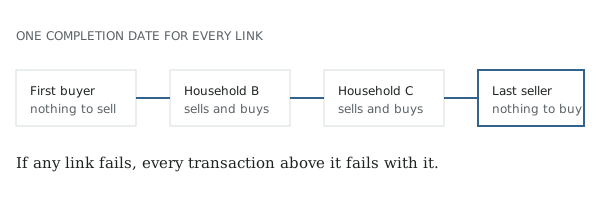
Completion is the transfer of money and possession, usually on a date agreed at exchange. Where the purchase sits in a chain, completion has to be coordinated with every other transaction in it, which is why dates are negotiated as carefully as figures.
After completion the ownership record is updated and any tax on the transaction is dealt with. These are administrative rather than uncertain, but they are not instantaneous.