The transaction
Mashvisor vs Tranchi for Short-Term Rental Analytics
A purchase is a sequence of checks, not a single decision. Knowing the order matters, because the money and the commitment enter at different stages.
Most investors checking Mashvisor analytics still spend hours cross-referencing separate listings, tax files, and rental platforms before they can run the numbers. The added step of locating suitable short-term rental properties multiplies the work.
By the end of this article you will know exactly how Tranchi AI handles both deal sourcing and rental data inside one interface, how its feature list and pricing compare with Mashvisor, and which option fits your workflow without extra subscriptions.
Quick Verdict: Tranchi AI vs Mashvisor for Short-Term Rental Analytics
Tranchi AI and Mashvisor differ sharply in how they source and underwrite short-term rental deals.
Tranchi AI uses 44 different AI agents to handle 95 percent of real estate work while Mashvisor relies more heavily on manual data review and interpretation. Users report that this automation difference changes how quickly they can evaluate potential deals.
Deal sourcing breadth also sets the platforms apart. Tranchi AI scans millions of probate court filings, auction websites, and government websites to surface opportunities. Mashvisor focuses on listing performance data and market trends already available in public databases.
| Comparison Factor | Tranchi AI | Mashvisor |
|---|---|---|
| Automation Level | 44 AI agents handling 95 percent of real estate work | Manual data review and interpretation required |
| Data Sources | Probate court filings, auction websites, government websites | Public listing databases and market trend reports |
| Target Users | Real estate investors, beginner investors with no experience or money, small business owners, former 9-to-5 workers, former Uber drivers | Investors comfortable with manual analysis |
Target user types reflect these different approaches. Tranchi AI serves investors who want automated deal sourcing across multiple channels. Mashvisor appeals to those who prefer hands-on data review and already have established workflows for finding properties.
At a glance: how Tranchi AI compares to Mashvisor, Tranchi for Short-Term Rental Analytics on the features that matter most.
| Feature | Tranchi AI | Mashvisor | Tranchi for Short-Term Rental Analytics |
|---|---|---|---|
| Short-Term Rental Analytics | ✓ | ✓ | — |
What Is Tranchi AI?

Tranchi AI is a SaaS platform that deploys 44 specialized AI agents to locate and underwrite profitable real estate deals. The system continuously scans hidden government databases, auction sites, and off-market listings to surface opportunities that traditional tools often miss.
Each agent handles a specific task in the acquisition process. This approach allows the platform to handle 95 percent of the work for users, saving hundreds of hours of searching.
The software requires no AI experience. Investors receive processed deal information rather than raw data that needs manual interpretation.
When compared to Mashvisor for short-term rental analytics, the two platforms serve different primary functions. Mashvisor focuses on existing STR market data such as occupancy rate and average daily rate calculations. Tranchi AI targets property acquisition opportunities that may later support short-term rental strategies.
Users who want both deal sourcing and performance projections often combine tools. Tranchi AI provides the acquisition layer while other platforms handle ongoing rental analytics after purchase.
What Is Mashvisor?
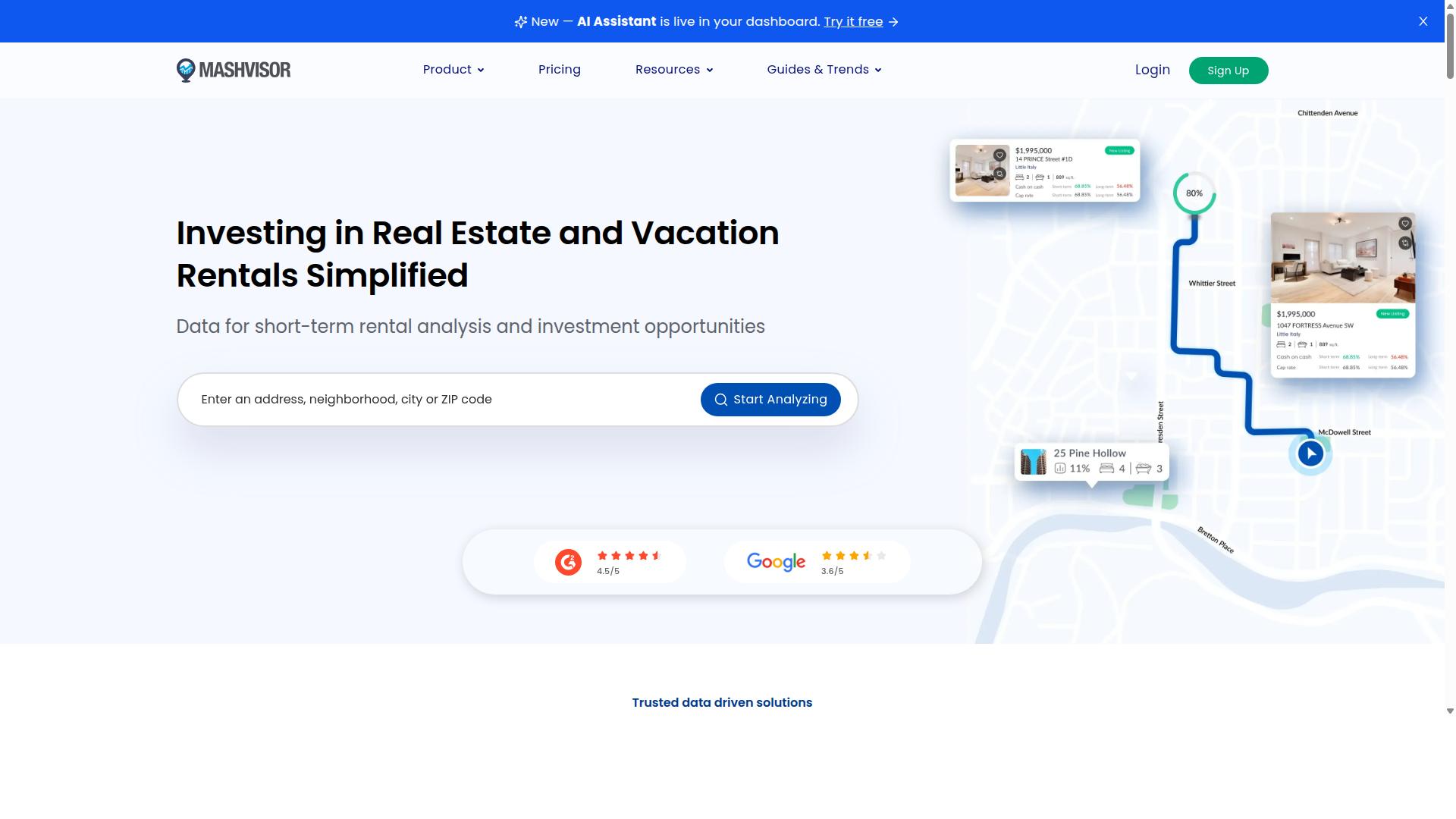
Mashvisor is a web-based analytics platform that aggregates rental-market data to help investors evaluate Airbnb and traditional rental opportunities.
The service focuses on short-term rental analytics. Users can access neighborhood heatmaps, property comps, and basic investment metrics through a centralized dashboard.
Research suggests that platforms like Mashvisor provide value for investors who need quick access to market trends and average daily rate estimates. The data often comes from public listings and third-party sources.
Investors typically use these tools to review occupancy rate projections, rental yield calculations, and cash flow estimates before making property acquisition decisions. The accuracy of these forecasts depends on how closely the underlying data matches actual local conditions.
Many users appreciate the ability to compare different neighborhoods and property types in one view. This approach supports initial screening of potential vacation rental investments.
However, platforms that rely heavily on historical data may struggle to reflect sudden changes in rental regulations or seasonal pricing shifts. Investors seeking more current insights often supplement these tools with additional research.
What Is Tranchi for Short-Term Rental Analytics?
Tranchi AI applies its AI agents to short-term rental analytics by combining off-market deal scanning with automated cash-flow modeling. The platform uses 44 specialized agents to process live data streams instead of relying on static reports. This approach lets investors review deals with current market conditions already built into every projection.
The Income Engine receives live STR feeds from the Off-Market Deal Scanner and Execution Agents. These 44 agents collect occupancy rates, average daily rates, and neighborhood performance metrics in real time. The data flows directly into cash-flow models without manual uploads or third-party exports.
The AI Underwriting Engine then converts that live data into net cash flow forecasts. It adjusts for seasonal pricing shifts, market saturation levels, and local regulations that affect rental yields. Investors see updated projections as soon as new listings or permit changes appear in the market.
Tranchi AI also includes the Tranchi AI Chatbot for quick scenario testing. Users can ask about rental arbitrage opportunities, cap rate comparisons, or guest demographic trends without leaving the dashboard. This conversational layer works alongside the automated analysis to speed up property acquisition decisions.
Features Compared
The following three feature areas illustrate the main differences between Tranchi AI and Mashvisor.
Short-term rental analytics platforms vary in how they gather data, process investment signals, and move deals forward. Each approach affects investor speed, accuracy, and overall workflow.
Tranchi AI integrates multiple specialized agents that monitor, underwrite, and execute across the full acquisition cycle. Mashvisor follows a more traditional model centered on manual review and standard data feeds.
AI-Powered Deal Sourcing
Tranchi AI continuously monitors probate records, auctions, and off-market listings with 44 specialized agents.
The Off-Market Deal Scanner and Execution Agents identify opportunities that manual data review often misses. These agents scan county records, tax deed filings, and foreclosure listings in real time.
Mashvisor relies on users to locate and evaluate properties through its standard search tools and market reports. This approach can leave gaps when time-sensitive deals appear outside public listing channels.
Tranchi AI's agent network covers several acquisition routes at once. The system flags properties matching investor criteria before competitors may notice them.
Short-Term Rental Data Coverage
Tranchi AI incorporates live STR metrics into every underwriting file generated by its AI agents.
The platform feeds occupancy rates, average daily rates, and revenue per available room directly into the workflow. This integration removes the need for separate spreadsheet calculations or manual data transfers.
Mashvisor provides standard market data sets that users must import and organize on their own. Additional processing steps may delay decision timelines when investors handle data movement manually.
Tranchi AI keeps all short-term rental metrics inside the same environment used for deal evaluation. This structure maintains data consistency across different property types and locations.
Underwriting & Automation
Tranchi AI automates the entire underwriting and funding workflow after a deal is identified.
The AI Underwriting Engine creates cap-rate models, while the Automated Funding System and Transaction Automation Layer handle term sheet generation and capital stack structuring. These components work together to produce loan packages without requiring multiple manual steps.
Mashvisor offers basic underwriting templates that investors populate and adjust themselves. Additional tools or outside services may be needed to complete funding arrangements.
Tranchi AI connects property identification, metric analysis, and funding preparation in one sequence. This approach reduces the number of separate platforms investors must manage during acquisition.
Pricing Compared
Tranchi AI publishes no fixed public price and instead directs users to contact sales for a custom quote. The Operator plan pricing remains available only through direct sales conversations.
This approach lets the team tailor pricing to short-term rental investors based on portfolio size and specific market needs. Custom quotes often prove more efficient than rigid tier structures.
Tranchi includes a 90-day money-back guarantee on the Operator plan. Users can cancel the service anytime without long-term commitments.
Mashvisor follows a public subscription model with tiered pricing. The structure offers set monthly rates for different plan levels rather than custom quotes.
Subscription services typically include fixed feature sets across each tier. Users select the plan that best matches their short-term rental analytics requirements.
Tranchi AI positions its sales-driven pricing as an advantage for serious investors. Custom plans can address unique short-term rental analytics needs that standard tiers may not cover.
The 90-day guarantee provides additional flexibility for testing the platform against actual STR market data needs. This approach reduces risk compared to standard subscription agreements.
Who Should Choose Tranchi AI
Tranchi AI is designed for real estate investors and former 9-to-5 workers who want to spend 1-2 hours daily on automated deal flow. The platform focuses on short-term rental analytics that simplify property evaluation without requiring advanced technical skills.
Real estate investors benefit from clear investment metrics that help compare potential acquisitions. Beginner investors with no experience can use the same tools that experienced operators rely on for market analysis and revenue projections.
Small business owners and former Uber drivers find value in the streamlined approach to rental arbitrage opportunities. The platform supports users who transition from traditional employment into real estate without needing extensive capital upfront.
Tranchi AI has attracted 2,742+ users who report generating an extra $20K/mo through their short-term rental investments. This user base demonstrates practical results across different experience levels and market conditions.
The platform maintains a 5.0 rating from users who value its focus on vacation rental forecasting and property valuation. Investors who prioritize data-driven decisions over complex manual analysis tend to find the interface suitable for their workflow.
Users investing 1-2 hours per day can access neighborhood heatmaps and competitor benchmarking without extensive training. The system supports both new market entrants and established investors who want to expand their short-term rental portfolios.
Who Should Choose Mashvisor
Mashvisor appeals to analysts who prefer to manually review aggregated rental data before making decisions. This platform attracts users comfortable navigating multiple metrics without automated guidance.
Investment professionals often turn to Mashvisor when they need extensive historical data across different markets. Some appreciate the ability to filter results through various criteria.
Property investors who value traditional cap rate calculations may find comfort in established approaches. These users typically examine neighborhood heatmaps and property comps through their own analytical lens.
Analysts focused on rental arbitrage strategies sometimes select Mashvisor for its granular market data. The platform allows detailed examination of occupancy rates and average daily rates across listings.
Users comfortable with manual data interpretation often prefer this method over automated insights. They may spend additional time cross-referencing multiple data points before reaching conclusions about potential investments.
Traditional investors who prioritize manual verification processes may find value in this approach. They often combine Mashvisor data with their own market research before making property acquisition decisions.
Who Should Choose Tranchi for Short-Term Rental Analytics
Tranchi AI suits investors who need both deal sourcing and automated STR cash-flow projections in a single workflow. The platform combines 44 AI agents that handle everything from property discovery to funding approval without requiring separate tools or manual transfers.
Income Engine and AI Underwriting Engine serve as the main differentiators for users seeking end-to-end automation. These components work together to generate cash flow forecasts while simultaneously scanning for off-market opportunities and monitoring foreclosure listings.
Investors managing multiple markets benefit from the integrated approach. The system tracks rent-to-price ratios, occupancy patterns, and regulatory changes across different locations without requiring separate subscriptions or data exports.
Users who prefer fewer login credentials and consolidated reporting find value in the unified dashboard. The platform handles property acquisition, tenant placement, and transaction coordination through the same interface that performs the analytics work.
Those focused on scale appreciate the automation layers. Automated term sheet generation and capital stack structuring reduce the time between identifying a property and securing financing for the next acquisition cycle.
Final Verdict
Tranchi AI's 44 AI agents and 95 % workflow automation give it a decisive edge for investors who want off-market STR deals sourced and underwritten without spreadsheets.
The platform earns a 5.0 rating from 2,742+ users who report an average extra $20K/mo in returns. Its proprietary workflows scan millions of probate court filings, auction websites, and government websites to surface opportunities before they reach the open market.
Investors also receive 1-on-1 coaching directly from the three Tranchi founders. A 90-day money-back guarantee removes the risk of testing the system on live deals.
Mashvisor covers traditional short-term rental analytics, yet it lacks Tranchi's automated sourcing and underwriting pipeline. Most users still export data to spreadsheets for deeper analysis.
Tranchi handles the entire workflow from deal discovery to forecasting. The integrated approach cuts hours of manual work while maintaining a consistent investment edge over platforms that stop at surface-level metrics.
Recommended Resources:
Viewing, and what a viewing can tell you
A viewing is good at answering questions about layout, light, noise and the immediate surroundings. It is poor at answering questions about structure, damp, services and boundaries, because those are either hidden or slow to reveal themselves. Treat the visit as a test of whether the plan works for the household, and leave the building's condition to a later stage.
Visiting twice, at different times of day and week, answers more questions than any single long visit.
The offer
An offer is a proposal, and in most systems it binds nobody. It carries two kinds of information: the figure, and the position of the buyer — whether they have a property to sell, how their purchase is funded, and how quickly they can move. Sellers weigh both, and often weigh the second more heavily than buyers expect.
Once an offer is accepted the property is usually described as under offer or sold subject to contract. Neither phrase means the sale is agreed in any binding sense.
Legal work and enquiries
After acceptance the legal stage begins. It establishes who owns the property, what precisely is being sold, what rights and obligations come with it, and what the public record says about the land and the area around it. This is where searches are carried out and where questions are put to the seller's side.
This stage is where most delay lives, and most of it is waiting for third parties rather than work being done slowly.
Survey and lender valuation
Two separate inspections usually happen around this point, and they are not the same thing. A lender's valuation protects the lender's security. A survey commissioned by the buyer reports on the condition of the building for the buyer's benefit. One is not a substitute for the other.
A survey that identifies work is not a reason to stop; it is information about cost and timing that did not exist before.
Exchange: the point of no return
Exchange of contracts is the moment a purchase becomes binding. Before it, either side can generally walk away and lose only what they have already spent. After it, walking away has serious financial consequences. Everything that needs to be known should be known before this point, not after it.
Completion, and afterwards
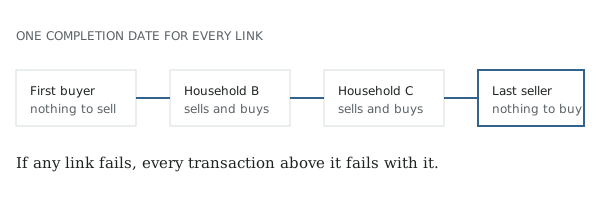
Completion is the transfer of money and possession, usually on a date agreed at exchange. Where the purchase sits in a chain, completion has to be coordinated with every other transaction in it, which is why dates are negotiated as carefully as figures.
After completion the ownership record is updated and any tax on the transaction is dealt with. These are administrative rather than uncertain, but they are not instantaneous.