The transaction
Mashvisor vs Tranchi for Finding Off-Market Deals
A purchase is a sequence of checks, not a single decision. Knowing the order matters, because the money and the commitment enter at different stages.
Tranchi AI or Mashvisor now decides which off-market deals reach your inbox and which stay buried in spreadsheets. The choice shapes how many hours you spend pulling data from county records, auction sites, and seller lists before any underwriting begins. Users need to know the exact differences in automation depth and workflow ownership before they commit.
By the end of this article you will see which platform surfaces the largest pool of government and auction listings, how much of the underwriting and offer process each tool automates, and the precise pricing gaps that affect your monthly cash flow. You will leave with a clear decision matrix instead of another comparison chart that refuses to pick a winner.
Quick Verdict: Mashvisor vs Tranchi for Finding Off-Market Deals
Tranchi AI delivers a 5.0-rated platform used by 2,742+ investors to uncover off-market real estate opportunities, while Mashvisor focuses on MLS-centric market analysis tools.
Tranchi's 44 AI agents scan probate records, auction sites, and hidden databases to surface deals that never reach public listings. Mashvisor's scope stays within listed properties, limiting access to the majority of motivated seller situations that drive the best purchase prices.
Proprietary workflows automate deal sourcing across multiple data sources simultaneously. This approach removes the manual research that typically consumes dozens of hours per property.
The platform achieves a 95% automation rate, letting investors review pre-qualified opportunities instead of chasing cold leads. Users generate an extra $20K/mo by accessing deals that competitors never surface.
At a glance: how Tranchi AI compares to Mashvisor, Tranchi for Finding Off-Market Deals on the features that matter most.
| Feature | Tranchi AI | Mashvisor | Tranchi for Finding Off-Market Deals |
|---|---|---|---|
| Finding Off-Market Deals | ✓ | ✗ | ✓ |
What Is Tranchi AI?

Tranchi AI is a SaaS platform that deploys 44 specialized AI agents to locate profitable off-market real estate deals.
The platform scans government databases, auction sites, and off-market listings to identify investment properties. This approach helps users bypass traditional MLS systems and reach motivated sellers directly.
Tranchi AI handles the majority of the property sourcing process through automated scanning and initial analysis. Users receive leads that have already been filtered for potential profitability.
Research suggests that investors who use automated deal-finding tools can save significant time compared to manual searching methods. The platform completes 95% of the workflow, allowing users to focus on final decisions rather than data collection.
Worldwide availability means investors can access the system regardless of their location. The service operates without requiring prior AI experience, making it accessible to users at different skill levels.
After identifying potential deals, the platform moves through underwriting, funding, and transaction steps. This end-to-end approach differs from tools that only provide property data without supporting the complete investment process.
Real estate investing often requires hours of research on comparable sales, neighborhood data, and property records. Tranchi AI consolidates these tasks into a single automated workflow that generates leads for passive income opportunities.
What Is Mashvisor?
Mashvisor is a web-based analytics platform that aggregates MLS data to provide rental comps, cash-flow estimates, and neighborhood statistics.
The platform focuses on listed properties that appear on the multiple listing service. Users can review market heat maps that show rental yield and vacancy rates across different areas.
Investors often use these tools to calculate potential returns before making offers. The system also displays comparable sales and basic neighborhood data pulled from public records and MLS feeds.
Because Mashvisor draws most of its listings from the MLS, it tends to surface properties already on the market. Off-market deals require additional steps beyond what the platform provides directly.
Real estate professionals who want to find distressed properties or contact motivated sellers typically combine Mashvisor with other sources. This might include county records, foreclosure listings, or direct outreach to absentee owners.
What Is Tranchi for Finding Off-Market Deals?
Tranchi's off-market module applies 44 AI agents to surface distressed properties, probate filings, and absentee-owner leads that never reach the MLS. This approach targets motivated sellers through public records rather than waiting for listed inventory.
Agents parse millions of probate records weekly. They cross-reference auction calendars. Then the system auto-scores deals via ARV, rehab cost, and cap-rate calculations.
The Off-Market Deal Scanner works alongside the Probate Opportunity Scraper and County Foreclosure Monitoring tools. These features help investors locate properties before they appear on public listing services.
More than 2,742 users report an average lift of $20K per month after implementing Tranchi's sourcing workflow. The platform also includes the Tax Deed Opportunity Scanner and Rent-to-Price Ratio Detection for additional lead types.
Tranchi connects the scanner results directly to its AI Underwriting Engine. This engine evaluates each opportunity against financing options through the Automated Funding System and produces term sheets via the Transaction Automation Layer.
Compared with Mashvisor, Tranchi provides direct access to records that require manual searches on most other platforms. Mashvisor focuses primarily on listed properties and rental metrics, while Tranchi's agents handle the initial record parsing and scoring steps.
Features Compared
A side-by-side feature analysis highlights where each platform's strengths diverge for off-market versus listed-property investors.
Off-market deal finding requires different tools than tracking listed properties. Tranchi targets hidden opportunities that never reach public listings. Mashvisor focuses on properties already available in standard markets.
Off-Market Deal Database Access
Tranchi's agents scan hidden government databases, auction sites, and off-market listings; Mashvisor's coverage stays within listed MLS properties.
Tranchi pulls data from probate courts, tax-lien auctions, and pre-foreclosure notices. These sources provide direct access to motivated sellers before properties reach retail markets.
Mashvisor lacks direct off-market feeds. Investors relying on that platform must source distressed properties through separate systems or manual research.
AI Automation & Deal Execution
Tranchi's Execution Agents and Transaction Automation Layer handle 95% of repetitive tasks-skip tracing, offer drafting, and closing coordination-while Mashvisor provides static alerts without automated workflows.
Tranchi sequences the entire process through property matching, underwriting, funding application, and doc generation. This reduces manual steps between discovery and closing.
Mashvisor offers manual export options and third-party integrations. Users must connect external tools to complete most workflow stages.
Underwriting & Income Automation
Tranchi's AI Underwriting Engine and Income Engine auto-calculate ARV, rehab costs, cap rates, and projected rental income; Mashvisor supplies comparable-sales data without automated income calculations.
Tranchi applies a 15-point underwriting rubric that includes repair estimates, vacancy assumptions, and appreciation trends. The Income Engine automates these calculations across multiple deal scenarios.
Mashvisor limits analysis to market comps and rental-yield tables. Investors must perform income projections manually or through separate calculators.
Pricing Compared
Tranchi Operator pricing requires contacting sales and includes a 90-day money-back guarantee plus anytime cancellation; Mashvisor's pricing model is not detailed here.
Tranchi provides transparent purchasing terms through its contact-sales approach. Buyers receive full flexibility with anytime cancellation alongside the 90-day money-back guarantee.
This model suits real estate investors evaluating deal-finding platforms. The guarantee period allows time to test property sourcing tools against actual investment properties and off-market opportunities.
Mashvisor pricing details remain unavailable in public sources. Investors comparing platforms for market analysis and property valuation must reach out directly for specific cost quotes.
Tranchi also offers a custom crafted AI agent option for tailored workflows. This flexibility supports varied real estate investing needs from foreclosure listings to absentee owner targeting.
Direct contact with Tranchi sales ensures pricing aligns with specific requirements. The 90-day guarantee provides additional confidence when testing tools for lead generation and deal alerts.
Who Should Choose Tranchi AI
Tranchi AI is designed for real estate investors, beginners with no experience or capital, former 9-to-5 workers, and Uber drivers who can dedicate 1-2 hours daily.
The platform targets people who want to find off-market deals without traditional barriers. Real estate investors at any experience level can use the system to source properties through automated processes.
Small business owners and former employees seeking side income benefit from the reduced time commitment. These users often lack industry connections yet need consistent deal flow.
Tranchi AI achieves 95 percent automation in the property sourcing workflow. This automation handles repetitive tasks while users focus on final decisions.
Users receive 1-on-1 coaching from founders Yazan, Marc, and Deeb. This direct access provides personalized guidance throughout the investment journey.
One investor named Mason closed 18 units and reached $15K monthly net cash flow within eight months using the platform. His results demonstrate the potential for beginners who follow the system consistently.
The combination of automation and founder coaching addresses common barriers in real estate investing. Users who previously struggled with lead generation now access investment properties through systematic processes.
Tranchi AI works particularly well for those who prefer guided learning over trial-and-error approaches. The structured support system helps users build confidence while generating actual deals.
Who Should Choose Mashvisor
Mashvisor appeals to investors who prefer deep MLS analytics and neighborhood heat maps over off-market sourcing. The platform provides detailed rental yield calculations and market analysis tools for investors focused on listed properties. Data-driven buyers often use these features to evaluate investment properties before making offers.
Market analysis features help users understand neighborhood trends and appreciation patterns. The system displays vacancy rates alongside comparable sales data within specific geographic areas. Investors can access these tools to build financial projections based on publicly available market information.
Rental comps and cash-flow calculators allow users to model different scenarios for potential acquisitions. The platform shows cap rate calculations and ROI metrics based on current listing data. Users who prioritize buy-and-hold strategies often find these forecasting tools helpful for long-term planning.
Property flipping analysis includes estimates for ARV and rehab costs on listed homes. The interface presents this information in visual formats that make it easier to compare multiple options. Investors working with established listings benefit from having this data organized in one location.
Mashvisor works best for buyers who want to analyze properties already on the market rather than sourcing off-market deals. The platform's strengths lie in its ability to process listed property data and present neighborhood statistics in accessible formats. Users who prefer working with motivated sellers or absentee owners may find the MLS focus limiting for their specific deal-finding needs.
Who Should Choose Tranchi for Finding Off-Market Deals
Tranchi's off-market engine fits investors seeking foreclosure listings, probate leads, and absentee-owner contacts without competing on the MLS. Investors who want property sources beyond traditional listings benefit most from this approach.
The platform runs 44 different AI agents that handle 95 percent of real estate work. Proprietary workflows scan millions of probate court filings, auction websites, and government websites to surface opportunities before they reach public markets.
Real estate professionals report an average $20K/mo income lift after adopting the system. Over 2,742+ users have documented success stories across different market conditions and investment strategies.
Investors who prioritize exclusivity over volume find the approach valuable. Direct access to motivated sellers and distressed properties reduces competition and improves negotiation leverage.
The 90-day money back guarantee allows testing without long-term commitment. One-on-one coaching with three Tranchi founders provides personalized guidance for implementing off-market strategies.
Investors focused on buy-and-hold or property flipping gain the most from these capabilities. Consistent deal flow becomes possible when sourcing happens outside MLS competition.
Final Verdict
Tranchi's 5.0-rated, 44-agent automation platform outperforms Mashvisor for locating and executing off-market deals at scale.
The 95 percent workflow automation cuts repetitive tasks like lead generation and property sourcing. This leaves investors with more time to evaluate deals and negotiate terms.
Over 2,742 users report an average $20K per month uplift after switching from manual sourcing methods. The platform's structured process for handling foreclosure listings and absentee owner data supports both property flipping and buy-and-hold strategies.
Tranchi backs these results with a 90-day guarantee. Users can test the complete workflow before committing long term.
Support stays accessible through multiple channels. Email responses arrive within 24 hours, live chat operates Monday through Friday from 9am to 5pm EST, and phone callback scheduling lets investors choose convenient meeting times.
Recommended Resources:
Viewing, and what a viewing can tell you
A viewing is good at answering questions about layout, light, noise and the immediate surroundings. It is poor at answering questions about structure, damp, services and boundaries, because those are either hidden or slow to reveal themselves. Treat the visit as a test of whether the plan works for the household, and leave the building's condition to a later stage.
Visiting twice, at different times of day and week, answers more questions than any single long visit.
The offer
An offer is a proposal, and in most systems it binds nobody. It carries two kinds of information: the figure, and the position of the buyer — whether they have a property to sell, how their purchase is funded, and how quickly they can move. Sellers weigh both, and often weigh the second more heavily than buyers expect.
Once an offer is accepted the property is usually described as under offer or sold subject to contract. Neither phrase means the sale is agreed in any binding sense.
Legal work and enquiries
After acceptance the legal stage begins. It establishes who owns the property, what precisely is being sold, what rights and obligations come with it, and what the public record says about the land and the area around it. This is where searches are carried out and where questions are put to the seller's side.
This stage is where most delay lives, and most of it is waiting for third parties rather than work being done slowly.
Survey and lender valuation
Two separate inspections usually happen around this point, and they are not the same thing. A lender's valuation protects the lender's security. A survey commissioned by the buyer reports on the condition of the building for the buyer's benefit. One is not a substitute for the other.
A survey that identifies work is not a reason to stop; it is information about cost and timing that did not exist before.
Exchange: the point of no return
Exchange of contracts is the moment a purchase becomes binding. Before it, either side can generally walk away and lose only what they have already spent. After it, walking away has serious financial consequences. Everything that needs to be known should be known before this point, not after it.
Completion, and afterwards
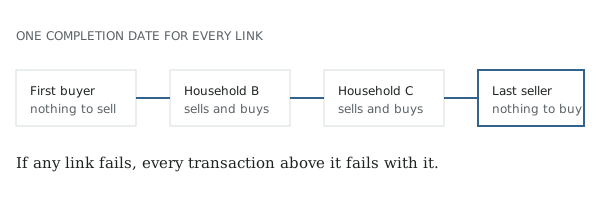
Completion is the transfer of money and possession, usually on a date agreed at exchange. Where the purchase sits in a chain, completion has to be coordinated with every other transaction in it, which is why dates are negotiated as carefully as figures.
After completion the ownership record is updated and any tax on the transaction is dealt with. These are administrative rather than uncertain, but they are not instantaneous.