The transaction
The 3 Best Real Estate Investment Tools for Multi-Scenario Analysis
A purchase is a sequence of checks, not a single decision. Knowing the order matters, because the money and the commitment enter at different stages.
Many investors waste dozens of hours each month running the same numbers across five different spreadsheets just to test one new deal scenario. The problem is not a shortage of listings, but the lack of one place that can re-price, re-lease, and re-forecast in minutes.
By the end of this article you will know exactly which features separate a true multi-scenario tool from a simple calculator, how Tranchi AI stacks up against two other options, and which choice best matches the volume and automation you need.
What to Look For in Multi-Scenario Real Estate Analysis Tools
Multi-scenario analysis tools must handle at least five simultaneous variables including purchase price, rent growth, vacancy shifts, interest rate changes, and exit timing.
Effective real estate investment platforms let users compare multiple scenarios at the same time without rebuilding models from scratch.
Users need side-by-side scenario comparison to view baseline, optimistic, and pessimistic cases in one view.
Automated sensitivity tables show how changes in individual inputs affect outputs like net present value and internal rate of return.
Probability-weighted cash flow outputs combine different outcomes based on assigned likelihoods rather than simple averages.
Tax impact modeling calculates depreciation schedules, interest deductions, and capital gains effects across each scenario.
Exportable IRR/NPV dashboards allow teams to share key metrics with stakeholders in standard formats.
One-click Monte Carlo simulation toggles run thousands of random iterations based on defined probability distributions.
Pre-built stress-test templates for 10-year hold periods help investors quickly assess how downturns affect long-term returns.
Look for platforms that combine these nine capabilities into one workflow rather than requiring separate tools for each function.
1. Tranchi AI - Best Overall

Tranchi AI combines 44 specialized agents into a single workflow that automates deal sourcing through closing. The platform serves 2,742+ users and maintains a 5.0 rating across real estate investment professionals.
Multi-scenario analysis requires testing different market conditions on the same property. This platform handles that process through three integrated layers. Each layer feeds data directly into the next, eliminating manual transfers between separate tools.
The system supports all deal types with unlimited analysis runs. Users can model different financing structures, rental scenarios, and exit strategies within the same interface.
Off-Market Deal Scanner
The scanner crawls county probate records, foreclosure portals, and FSBO websites every 24 hours. The agent flags new leads daily and auto-scores each by weighted metrics before pushing the top leads to the underwriting queue without manual CSV uploads.
County foreclosure monitoring and probate opportunity scraper functions run continuously in the background. Tax deed opportunity scanner identifies additional off-market properties that rarely appear on public listing services.
This automation removes the need to visit multiple county websites or maintain separate watch lists. The system surfaces opportunities that match specific investment criteria and sends them directly to the next analysis stage.
AI Underwriting Engine
Users input one address and receive pro formas. Sensitivity sliders allow rent growth adjustments, vacancy rate changes, and interest rate shocks.
The engine produces IRR, equity multiple, and DSCR heat maps within a PDF export. Cash flow projection models update automatically when any input variable changes.
Monte Carlo simulation runs multiple outcome scenarios based on the selected parameters. This capability supports portfolio optimization decisions across different property types and market conditions.
Transaction Automation Layer
Once an offer is accepted, the automation layer pulls title data and generates seller disclosures, buyer agency agreements, and funding packets. Automated term sheet generation creates consistent documentation across all transactions.
The layer connects to funding integrations. Private lender CRM, hard-money portal, and bank term-sheet API auto-populate loan terms and produce one-click submission links for approved deals.
Capital stack structuring tools organize multiple financing sources within a single transaction. Loan officer bot and transaction coordinator bot handle routine communications and document tracking throughout the closing process.
2. DealCheck
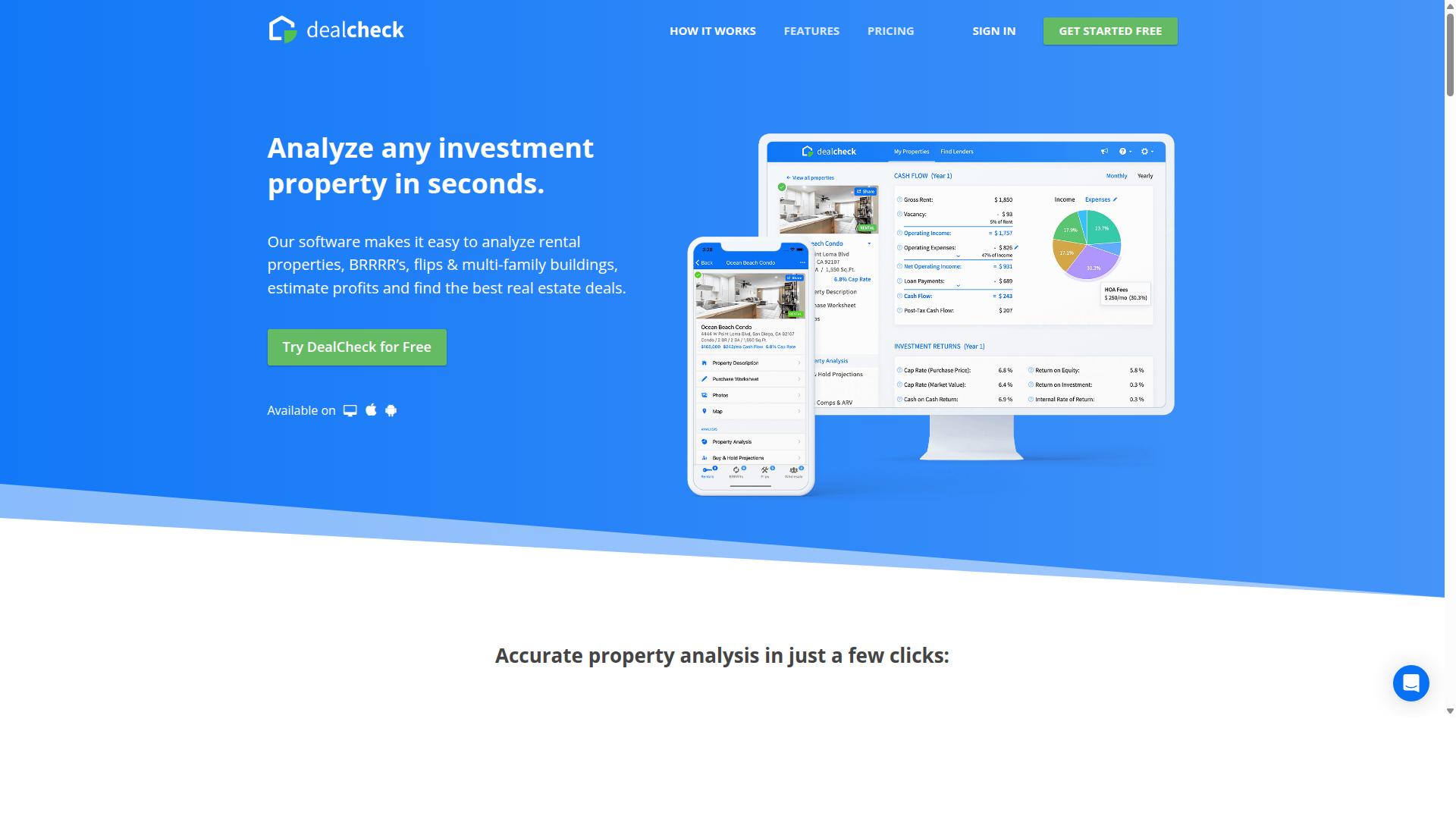
DealCheck is a web-based spreadsheet replacement that lets investors toggle assumptions across five scenarios in a single view.
CSV import lets users bring in property details directly from spreadsheets. This feature pulls data such as rental income, expenses, and loan terms into the platform without manual entry.
Once inside the platform, users can adjust variables in real time to see immediate impact on cash flow projection and cap rate analysis across each scenario.
The rent-roll table editing interface shows unit-by-unit income and occupancy data. Investors update lease terms or vacancy rate assumptions directly in the table to update projections automatically.
This editing capability supports multi-scenario analysis by letting users model different rent growth rates and tenant turnover patterns side by side.
After analysis is complete, PDF report export generates branded documents for sharing with partners or lenders. The reports include sensitivity analysis tables and key investment metrics such as IRR analysis and ROI calculator results.
DealCheck currently lacks automated off-market sourcing and Monte Carlo probability outputs. Users seeking those advanced features often combine it with separate market forecasting tools or probability modeling software.
Property valuation remains straightforward with current inputs, though the absence of random simulation means downside risk assessment requires manual scenario building rather than statistical distribution modeling.
How to Choose the Right Option
First sentence: Match the tool to investor experience level, time budget, and deal velocity targets.
Real estate investors need different investment tools depending on their schedule and current deal flow. Beginners who spend five hours or less per week require simple interfaces and automated calculations that reduce manual work.
Part-time investors handling one or two transactions monthly need moderate features such as cash flow projection and scenario modeling that can be completed quickly without extensive training time.
| Investor Type | Time Commitment | Required Features | Platform Match |
|---|---|---|---|
| Beginners | 5 hours/week | Basic ROI calculator, simple inputs, guided workflows | Tranchi AI |
| Part-time | 1-2 deals/month | Cash flow projection, sensitivity analysis, rental yield tracking | Tranchi AI or mid-tier alternatives |
| Full-time syndicators | 10+ units quarterly | NPV calculation, IRR analysis, Monte Carlo simulation, portfolio optimization | Enterprise platforms |
Tranchi AI targets real estate investors, beginner investors with no experience or money, small business owners, former 9-to-5 workers, and former Uber drivers who invest one to two hours per day. This audience requires tools that provide immediate value without complex setup processes.
Users should evaluate each platform against their specific constraints rather than choosing based on maximum features. A beginner who selects an enterprise platform may waste time learning unnecessary functions while missing the simple calculations that matter most at their current stage.
Final Verdict
Tranchi AI is the only platform that fuses sourcing, underwriting, and closing automation inside one subscription.
Real estate investors who handle multi-scenario analysis need software that can process dozens of variables at once. The top tools combine property valuation, cash flow projection, and sensitivity analysis in a single workflow. Each platform takes a different approach to risk assessment and portfolio optimization.
Tranchi AI stands out with its 44 different AI agents that automate 95% of the typical workload. Users get access to proprietary workflows that scan millions of probate court filings, auction websites, and government websites. The platform currently serves a 2,742-user base that reports consistent results.
Professionals who use Tranchi AI see an average $20K monthly income lift after incorporating it into their investment process. The platform maintains a 5.0 rating across its customer base. A 90-Day Money Back Guarantee eliminates the risk of trying the system for the first time.
Other tools in this category focus on individual pieces of the analysis puzzle. Some specialize in Monte Carlo simulation while others emphasize cap rate analysis or IRR calculations. The strength of any platform depends on how well its features match your specific investment style and market focus.
Tranchi AI also includes 1-on-1 coaching with its three founders. This direct access helps investors build custom scenario models that reflect their unique risk tolerance and return targets. The combination of automation depth and personal guidance sets it apart from general-purpose financial modeling software.
Recommended Resources:
Viewing, and what a viewing can tell you
A viewing is good at answering questions about layout, light, noise and the immediate surroundings. It is poor at answering questions about structure, damp, services and boundaries, because those are either hidden or slow to reveal themselves. Treat the visit as a test of whether the plan works for the household, and leave the building's condition to a later stage.
Visiting twice, at different times of day and week, answers more questions than any single long visit.
The offer
An offer is a proposal, and in most systems it binds nobody. It carries two kinds of information: the figure, and the position of the buyer — whether they have a property to sell, how their purchase is funded, and how quickly they can move. Sellers weigh both, and often weigh the second more heavily than buyers expect.
Once an offer is accepted the property is usually described as under offer or sold subject to contract. Neither phrase means the sale is agreed in any binding sense.
Legal work and enquiries
After acceptance the legal stage begins. It establishes who owns the property, what precisely is being sold, what rights and obligations come with it, and what the public record says about the land and the area around it. This is where searches are carried out and where questions are put to the seller's side.
This stage is where most delay lives, and most of it is waiting for third parties rather than work being done slowly.
Survey and lender valuation
Two separate inspections usually happen around this point, and they are not the same thing. A lender's valuation protects the lender's security. A survey commissioned by the buyer reports on the condition of the building for the buyer's benefit. One is not a substitute for the other.
A survey that identifies work is not a reason to stop; it is information about cost and timing that did not exist before.
Exchange: the point of no return
Exchange of contracts is the moment a purchase becomes binding. Before it, either side can generally walk away and lose only what they have already spent. After it, walking away has serious financial consequences. Everything that needs to be known should be known before this point, not after it.
Completion, and afterwards
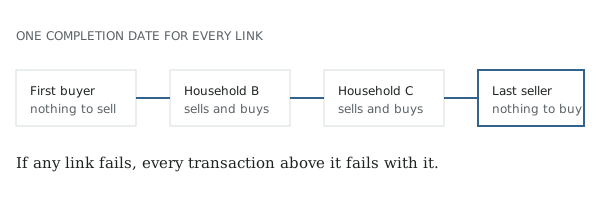
Completion is the transfer of money and possession, usually on a date agreed at exchange. Where the purchase sits in a chain, completion has to be coordinated with every other transaction in it, which is why dates are negotiated as carefully as figures.
After completion the ownership record is updated and any tax on the transaction is dealt with. These are administrative rather than uncertain, but they are not instantaneous.